|
|---|
Partial History the IBM PC |
- 1967: IBM builds the worlds first floppy disk.
- 1967: IBM introduces the worlds first 8" floppy disk.
- 1973: IBM introduces the IBM 3340 hard disk unit, known as the Winchester.
- 1975: September - IBM's Entry Level Systems unit unveils "Project Mercury",
the IBM 5100 Portable Computer.
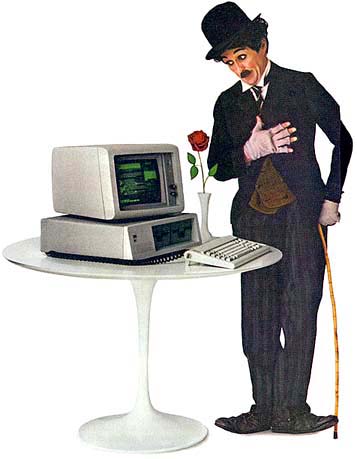
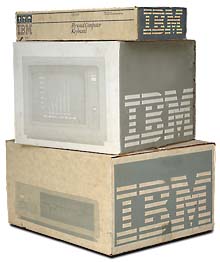
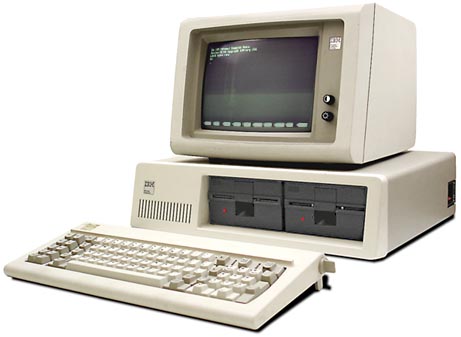
- 1981: September - IBM ships the IBM 5150 PC Personal Computer.
- 1982: April - Eight months after the introduction of the IBM PC, 50,000 units have been sold.
- 1982: May - Microsoft releases MS-DOS 1.1 to IBM, for the IBM PC.
- 1982: June - The first IBM PC clone, the MPC, is released by Columbia Data Products.
- 1982: August - After one year of production, IBM ships the 200,000th IBM PC.
- 1982: November - Compaq Computer introduces the
Compaq Portable PC, the first 100% IBM compatible. It cost Compaq US$1 million to create an IBM-compatible ROM BIOS that did not
violate IBM's copyright.
- 1982: At the West Coast Computer Faire, Davong Systems introduces its 5MB Winchester Disk Drive
for the IBM PC, for US$2000.
- 1983: March - IBM announces the IBM PC XT, with a 10 MB hard drive,
128KB RAM and a 360KB floppy drive. It costs US$5000.
- 1983: November - IBM announces the IBM PCjr.
It is US$700 for the bare configuration.
- 1984: February - IBM introduces the IBM Portable PC.
- 1984: March - IBM ships the IBM PCjr. It uses the 8088 CPU, 64KB RAM, and one 5.25-inch disk drive, but no monitor. It costs US$1300.
- 1984: August - IBM announces the PC AT, for US$4000-6700.
- 1985: April - IBM abandons production of the IBM PCjr.
- 1986: April - IBM announces the IBM PC Convertible, 80C88-based, 256K RAM, and two 720K floppy disks, for US$2000.
- 1986: April - IBM discontinues the IBM Portable PC.
- 1986: September - IBM announces the IBM PC-XT Model 286, with 640KB RAM, 1.2MB floppy drive, 20MB hard drive, serial/parallel ports, and keyboard for US$4000.
- 1987: IBM discontinues the IBM PC (model 5150) line.
Source:
Chronology of Events in the History of Microcomputers
| |
|---|
|
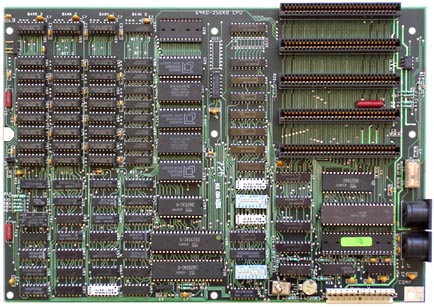
 Five internal
ISA expansion slots on the motherboard provide the ability to add additional memory and other capabllities,
although one slot is usually occupied by the video card, and another by the optional floppy drive controller.
A third slot typically has an RS-232 serial port card installed.
A modem card
for dialing-up remote computer systems became a popular option as well.
Five internal
ISA expansion slots on the motherboard provide the ability to add additional memory and other capabllities,
although one slot is usually occupied by the video card, and another by the optional floppy drive controller.
A third slot typically has an RS-232 serial port card installed.
A modem card
for dialing-up remote computer systems became a popular option as well.